
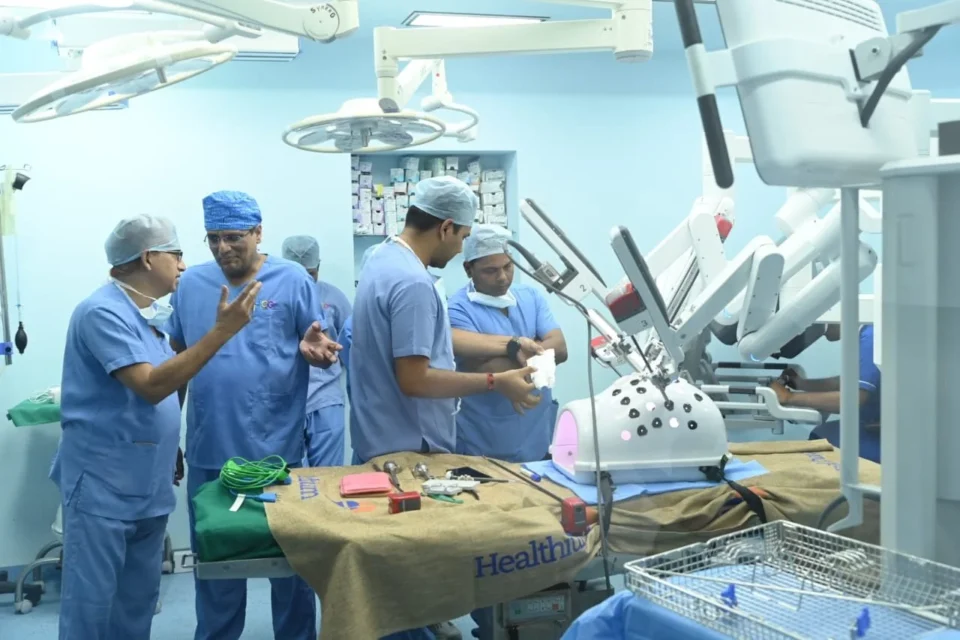
In an Indian operating theatre, the patient meets the surgeon for a few minutes before the procedure begins. Identity, anaesthesia plan, the briefest reassurance. For most surgeries, the gender of the surgeon is incidental. For gynaecological cancer surgery, which involves the most intimate parts of a woman’s anatomy, at the most vulnerable moment of her life, the gender of the surgeon often matters more than patients are taught to admit.
A meaningful fraction of Indian women navigating a gynaecological cancer diagnosis specifically prefer a female gynaecological oncosurgeon. The reasons are practical, cultural, and personal, and the supply, until recently, has been unable to meet that preference.
Dr. Nishtha Tripathi Patel, an ESGO-certified woman gynaec oncologist practising in Ahmedabad, sits at the centre of that supply-demand gap.
The credential set
Dr. Nishtha’s training reads like a checklist of the sub-speciality’s most rigorous milestones. MBBS, DGO, DNB in obstetrics and gynaecology. Fellowship in gynaecological oncology. ESGO certification, a European Society of Gynaecological Oncology credentialing process that validates case volumes, examination performance, and ongoing continuing education at international standard. Twelve years of clinical experience. Over a thousand women guided through diagnosis and treatment.
The ESGO certification is worth dwelling on. It is not a brand the public encounters often, but it is one of the more meaningful credentials in the speciality. ESGO certification requires verified case logs across the full spectrum of gynaecological cancers, written and oral examination, and continued professional development. Dr. Nishtha is among a small group of Indian gynaec oncosurgeons holding the certification, and one of the few women among them.
The publication record
Beyond the clinical practice, Dr. Nishtha has authored peer-recognised academic work on topics that include:
- Cytoreductive surgery with HIPEC for advanced ovarian cancer
- PIPAC (pressurised intraperitoneal aerosol chemotherapy) for recurrent ovarian cancer
- ICG-guided sentinel lymph node biopsy after neoadjuvant chemotherapy
- Robotic peritonectomy with fluorescence guidance
- Enhanced recovery after surgery (ERAS) protocols in CRS-HIPEC
- Outcomes in secondary cytoreductive surgery for recurrent ovarian cancer
This is the work that distinguishes a clinician-surgeon from a surgeon who merely operates. The combination, clinical practice plus academic contribution to the literature, is what separates centres that perform procedures from centres that advance the field.
The practice
Dr. Nishtha’s practice operates across three Ahmedabad hospitals: Sterling Hospitals on Sindhubhavan Road (the primary centre for complex cytoreductive surgery, HIPEC, and robotic procedures), KD Hospital on Vaishnodevi Circle, and Welcare Speciality Hospital. All three are in west Ahmedabad’s tertiary healthcare corridor, reachable from most parts of the city within 15–30 minutes.
The case mix she handles spans the full range of gynaecological oncology: ovarian, cervical, endometrial, uterine, vaginal, vulvar, and fallopian tube cancers. The procedures span robotic radical hysterectomy, complex cytoreductive surgery, HIPEC, PIPAC, fertility-preserving surgery for young patients, and sentinel lymph node mapping.
Patients reach her practice from across Gujarat, Surat, Vadodara, Rajkot, Gandhinagar, and from neighbouring states including Rajasthan and Madhya Pradesh.
The female-surgeon question, taken seriously
The preference for a woman surgeon in gynaecological cancer is real, common, and rarely discussed openly. Some Indian women express it directly. Others express it indirectly, by repeatedly cancelling appointments with male surgeons, by deferring care, by accepting suboptimal care from a local female generalist rather than seek a male specialist.
Dr. Nishtha treats this preference as clinically valid. Comfort with the surgeon, the willingness to disclose symptoms honestly, to ask questions without embarrassment, to follow through with follow-up, affects outcomes in subtle but real ways. A patient who would feel embarrassed describing intimate symptoms to a male surgeon is a patient who may not get the work-up she needs. Removing that friction is itself a form of clinical care.
This is not a critique of male gynaec oncologists, who form the substantial majority of the sub-speciality in India and deliver excellent care. It is a recognition that for the subset of patients who prefer a female surgeon, having that option available is more than a stylistic preference.
The Ahmedabad-as-destination story
The broader story Dr. Nishtha’s practice fits into is Ahmedabad’s emergence as a serious destination for sub-speciality cancer care. Five to seven years ago, advanced gynaecological cancer surgery in Gujarat meant either accepting whatever local generalist care was available or travelling to Mumbai. The latter was inaccessible for most families.
Today, the procedures that previously required a Mumbai trip, HIPEC, robotic radical hysterectomy, PIPAC, fertility-preserving cancer surgery, are routinely performed in Ahmedabad, at materially lower cost, with sub-speciality teams operating to international standards. The infrastructure has matured. What remains is awareness, making sure women who need this care know it’s available locally and know how to access it.
What she tells patients
In conversation, Dr. Nishtha returns to a few practical points repeatedly:
“A second opinion is not betrayal of your first doctor. It’s a check on the diagnosis, the staging, and the proposed treatment. If your case is straightforward, the second opinion confirms the plan. If it isn’t, the second opinion gives you options.”
“For ovarian cancer, the most important decision is the surgical one, and the surgeon’s training is the most important variable in that decision. Asking specifically for a sub-speciality gynaec oncosurgeon is reasonable and appropriate.”
“Most cancer treatment decisions can wait a week or two for the right work-up. They don’t need to be made in the same conversation as the diagnosis. The urgency is real but the day-by-day urgency is overstated.”
“The Indian assumption that Mumbai is automatically better than Ahmedabad for cancer surgery is no longer true for most procedures. Equivalent clinical care is available locally at substantially lower cost.”
How to reach the practice
Dr. Nishtha’s practice accepts initial report reviews via WhatsApp at +91 76988 00333. In-person consultations are by prior appointment at any of the three hospitals.
For a profile of an ESGO-certified woman gynaec oncologist operating at the intersection of sub-speciality cancer surgery and the practical realities of women’s healthcare in Gujarat, Dr. Nishtha Tripathi Patel is among the practitioners reshaping what’s possible.
About this article
This profile of Dr. Nishtha Tripathi Patel (MBBS, DGO, DNB, Fellowship in Gynaecological Oncology, ESGO-certified) describes her practice as a gynaecological oncosurgeon based in Ahmedabad. Reach her practice at +91 76988 00333.
