
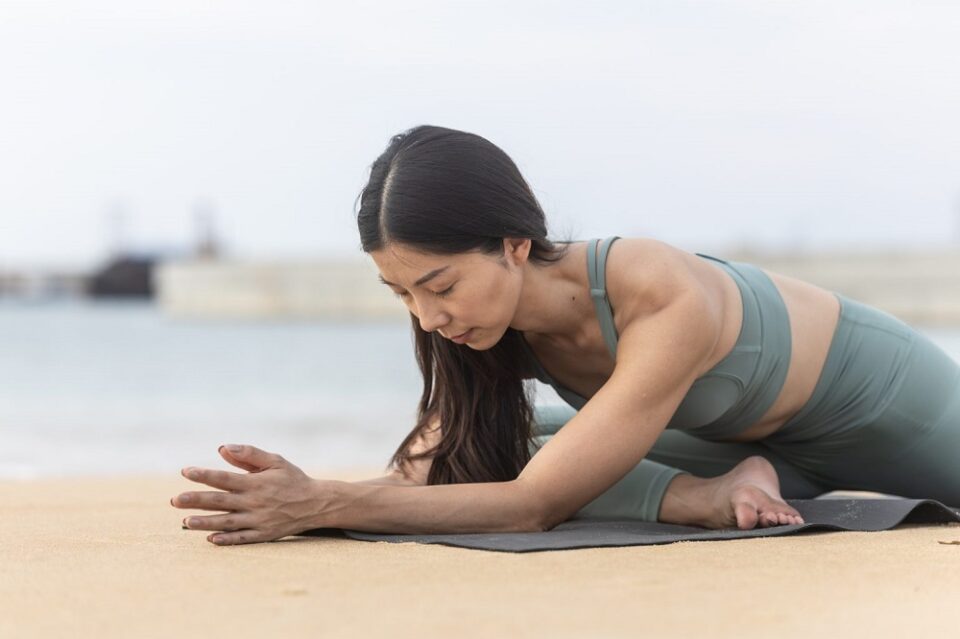
Strength athletes often arrive at recovery sessions with a clear sensation of tightness after squats, presses, pulls or high-volume accessory work. Using yin yoga to pursue the deepest possible stretch may feel productive, but greater range is not automatically what the body needs after demanding training.
A more useful approach is to select supported holds that reduce unnecessary effort, introduce comfortable movement options and leave the athlete prepared for the next priority session. Recovery practice should not quietly become another test of tolerance.
Post-Training Tightness Has Several Possible Sources
A muscle can feel tight because it is fatigued, sore, unfamiliar with a recent workload or responding protectively to stress. The sensation does not prove that the tissue has physically shortened.
This matters because aggressive stretching may not address the reason the area feels restricted. A strength athlete who completed heavy lower-body training may experience temporary stiffness that improves through rest, normal movement and time.
Yin practice can offer a slower environment for observing these sensations. It should not be used to force the body into its usual range immediately after training.
Recovery Requires a Different Objective
During strength work, the objective may be progressive overload, technical improvement or increased work capacity. During a recovery-focused Yin session, the objective changes.
Useful recovery goals include:
- Reducing unnecessary muscular effort.
- Exploring comfortable joint positions.
- Restoring calm breathing.
- Identifying areas of unusual sensitivity.
- Spending time outside common lifting positions.
- Finishing without significant additional fatigue.
- Supporting readiness for the next session.
None of these goals requires maximum pose depth.
A recovery session has succeeded when it fits the larger programme, not when it creates the strongest sensation.
Choose Positions According to Recent Training
The previous strength session should influence pose selection. After heavy squats or lunges, prolonged deep hip and thigh positions may feel more intense than expected. Following pulling work, the forearms, shoulders and upper back may need support rather than additional loading.
An athlete can ask three questions before settling into a hold:
- Which areas were trained most heavily?
- Is the current sensation muscular, joint-based or neurological?
- Will this position leave the area feeling more manageable afterwards?
If the answer to the second or third question is unclear, reduce the range or choose another position.
Props Change the Training Dose
Props are not only for people who lack flexibility. They change how much body weight is supported and how long a position can be maintained without strain.
A bolster can reduce the demand of a forward fold. Blocks can prevent the participant from dropping directly into end range. Blankets may reduce pressure beneath the knees, ankles or hips.
The correct setup allows the athlete to stop actively holding themselves in place while still maintaining comfort and an easy exit.
If the body continues to grip, the position may need more support or a shorter duration.
Avoid Turning Long Holds Into Endurance Tests
A long hold may expose changing sensations over time, but duration should remain adjustable. Staying because a timer has not finished can become unhelpful when discomfort increases.
An appropriate hold allows the participant to breathe, remain aware of the contact points and leave gradually. The position should be reduced or stopped if there is sharp pain, numbness, tingling or escalating joint pressure.
Muscular stretching sensations may change as the hold continues. They do not need to become increasingly intense for the practice to be effective.
Recovery Should Not Reduce Stability Before Lifting
Some athletes feel temporarily looser after prolonged passive stretching. If an important strength session follows soon afterwards, that change may affect how familiar positions feel.
This does not make Yin yoga incompatible with strength training. It means timing matters.
A longer recovery session may fit well after the week’s final heavy workout or before a rest day. Immediately before maximal or highly technical lifting, athletes may prefer shorter, more active preparation that matches the task.
The weekly programme should determine placement rather than habit.
Track the Next Session
The effect of recovery work cannot be judged only by how relaxed the athlete feels on the mat. The following training session provides important information.
Monitor:
- Readiness during the warm-up.
- Joint comfort under load.
- Stability in familiar positions.
- Unusual soreness.
- Perceived effort at normal weights.
- Confidence moving through the usual range.
- Overall energy.
If a particular Yin session repeatedly leaves the athlete feeling unstable, sore or less prepared, change its timing, range or duration.
Recovery methods should earn their place by supporting training.
Do Not Use Yoga to Diagnose an Injury
Persistent pain, significant weakness, swelling or neurological symptoms require assessment by an appropriate healthcare professional. Yin yoga should not be used to test whether such symptoms disappear under a longer stretch.
An instructor can modify known positions and work within professional guidance. They should not diagnose the source of pain or promise that passive holds will repair an injury.
Athletes should describe relevant training loads and symptoms before class.
Build a Repeatable Recovery Practice
At Yoga Edition, strength athletes can use Yin classes to explore supported, low-effort positions without treating flexibility as the primary score. Communicating recent training helps the instructor suggest appropriate ranges and props.
A practical recovery session may contain only a few positions, each selected for comfort and relevance. Progress can mean needing less muscular effort, recognising unsuitable sensations earlier or recovering more consistently before the next lift.
Strength athletes do not need to prove their recovery through deeper holds. The most useful Yin practice is one that broadens comfortable movement while respecting fatigue and preserving performance for the training that matters.
