
Modern life places relentless demands on human physiology. Between non-stop digital notifications, intense career obligations, and constant sensory input, the human nervous system frequently remains locked in a heightened state of alert. Over time, this chronic stress manifests as physical muscle tension, mental fatigue, digestive disturbances, and sleep disruption. While high-intensity exercise has its place in physical fitness, it adds another physical stressor to an already strained system.
Restorative yoga offers a powerful, therapeutic antidote to this modern exhaustion. Unlike dynamic or athletic styles of yoga that emphasize strength, flexibility, balance, and caloric expenditure, restorative yoga focuses entirely on deep physical release, conscious stillness, and nervous system down-regulation. By utilizing specialized props to fully support the body, this gentle practice allows practitioners to access a state of complete physiological relaxation without active effort or strain.
What Defines Restorative Yoga
Developed originally through the lineage of B.K.S. Iyengar and later popularized for stress relief by physical therapist Judith Hanson Lasater, restorative yoga is a receptive, floor-based practice. The fundamental goal is not to stretch muscles to their structural limits, but to create optimal physical comfort so the body feels entirely safe to let go of subconscious holding patterns.
A standard restorative yoga session includes only four to six postures held for extended periods, typically ranging from five to twenty minutes each. Throughout the session, the body is supported by an array of props, including firm bolsters, dense Mexican blankets, wooden or foam blocks, sandbags, and eye pillows. This external support removes all muscular effort, allowing the skeletal structure and deeper connective tissues to rest without fighting gravity.
The Science of Relaxation and Nervous System Balance
The profound relaxation experienced during restorative yoga is rooted in human neurobiology and autonomic function. The autonomic nervous system governs involuntary bodily functions through two primary divisions: the sympathetic branch and the parasympathetic branch.
-
Sympathetic Dominance: The sympathetic system drives the primal fight-or-flight response. When activated by psychological or environmental stressors, it increases heart rate, constricts blood vessels, elevates blood pressure, halts digestion, and floods the bloodstream with cortisol and adrenaline.
-
Parasympathetic Activation: The parasympathetic system drives the rest-and-digest mechanism. When engaged, it slows the heart rate, dilates peripheral blood vessels, stimulates digestive enzymes, supports immune cell proliferation, and initiates cellular repair processes.
Restorative yoga directly shifts the body from sympathetic overdrive into parasympathetic dominance. By resting in passive, supported postures combined with slow, rhythmic breathing, the vagus nerve is stimulated. This sends an immediate calming signal to the brainstem, which lowers systemic blood pressure, reduces serum cortisol levels, and fosters deep emotional composure.
Key Benefits of Restorative Yoga for Body and Mind
Practicing restorative yoga regularly provides comprehensive physical, psychological, and physiological benefits that extend far beyond the time spent on the mat.
-
Profound Relief of Musculoskeletal Tension: Sitting at desks and looking at screens causes chronic shortening of the hip flexors, rounding of the shoulders, and tightness across the cervical spine. Restorative postures gently decompress these areas without active muscular engagement, allowing tight fascia to soften naturally.
-
Reduction of Chronic Stress and Anxiety: By providing a structured, quiet environment free from performance metrics, the mind is given permission to disconnect from future-oriented planning and past rumination, lowering baseline anxiety.
-
Enhanced Sleep Quality and Circadian Regulation: The deep down-regulation of the nervous system prepares the brain for natural melatonin production, reducing sleep-onset latency and increasing the duration of slow-wave restorative sleep.
-
Improved Circulation and Lymphatic Flow: Passive inversions and gentle chest-opening shapes use gravity to drain pooled venous blood and lymphatic fluid from the lower extremities back toward the heart and lymph nodes for filtration.
-
Support for Immune System Resilience: Chronic elevation of stress hormones suppresses natural killer cell activity and increases systemic inflammation. Down-regulating stress through restorative rest restores natural immune defense mechanisms.
-
Cultivation of Somatic Awareness: Remaining still in supported postures sharpens interoception, which is the internal awareness of bodily sensations. This helps individuals recognize subtle early signs of physical stress before they escalate into pain.
Essential Restorative Yoga Postures
The following postures represent foundational shapes used in restorative yoga to release systemic tension and induce full-body relaxation.
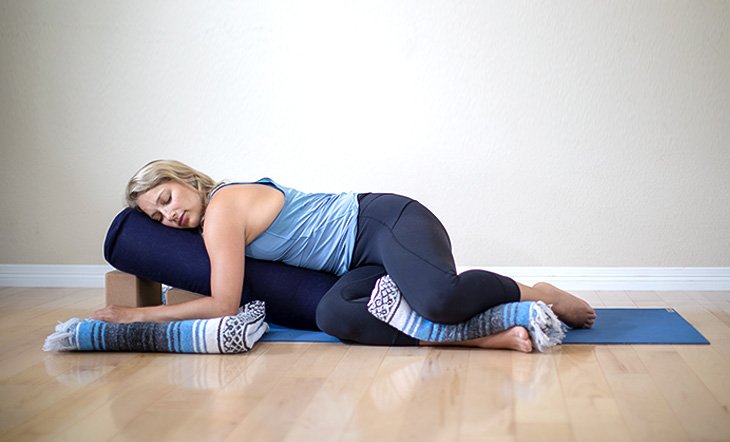
Supported Child Pose (Salamba Balasana)
This prone, forward-facing posture offers a powerful sense of physical safety and containment, making it ideal for soothing mental agitation and relieving lower back tightness.
-
Setup: Place a long, firm bolster lengthwise between wide knees while sitting on the shins. Fold forward from the hips, resting the entire torso, chest, and one cheek onto the surface of the bolster. Place folded blankets under the shins or feet if the ankles feel stiff.
-
Application: Let the arms drape softly on the floor alongside the cushion with elbows bent. Breathe into the back of the rib cage, allowing the lower back and pelvic floor to soften. Turn the head to the opposite side halfway through the hold.
Supported Reclining Bound Angle (Supta Baddha Konasana)
This restorative classic opens the front of the body, providing a passive stretch across the pectoral muscles, sternum, abdomen, and inner thighs.
-
Setup: Elevate a bolster on a slight slant using two yoga blocks behind your back. Sit at the base of the bolster, bring the soles of the feet together, and let the knees fall open. Place supportive blocks or rolled blankets beneath the outer thighs so the inner groin experiences zero pull.
-
Application: Recline fully back onto the slanted bolster with the head supported. Rest the arms outward with palms facing upward to encourage shoulder external rotation. Stay in this shape for ten to fifteen minutes while practicing slow nasal breathing.
Supported Bridge Pose (Setu Bandha Sarvangasana)
A gentle, supported inversion that decompresses the lumbar spine, opens the hip flexors, and stimulates the thyroid and parathyroid glands.
-
Setup: Lie flat on your back with knees bent and feet hip-width apart on the floor. Lift the pelvis and slide a yoga block or firm bolster directly underneath the sacrum, the flat bone at the base of the spine.
-
Application: Lower the hips onto the prop, ensuring the lower back feels comfortable and unsupported by muscular effort. Keep the arms relaxed by your sides. The elevated pelvis encourages venous return and calms an overactive heart rate.
Legs-Up-the-Wall (Viparita Karani)
This signature restorative shape relieves heavy, tired legs, supports cardiovascular recovery, and resets the nervous system after demanding physical or mental effort.
-
Setup: Place a folded blanket or flat bolster a few inches away from a clear wall. Sit sideways next to the wall, then swing the legs up against the wall while lowering your shoulders and head down onto the mat.
-
Application: The hips rest on the support while the back of the legs rest comfortably against the vertical wall. Place an eye pillow over the eyes to eliminate light stimulation and rest for ten to twenty minutes.
How to Create an Ideal Environment for Restorative Practice
Because the physical body cools down quickly during periods of prolonged stillness, environmental conditions play a crucial role in maintaining comfort during restorative yoga.
-
Maintain Warmth: When the body enters parasympathetic relaxation, metabolism slows, and peripheral blood vessels dilate, causing skin temperature to drop. Keep extra blankets nearby, wear warm socks, and cover the torso with a throw during long holds to prevent shivering.
-
Control Ambient Lighting: Bright overhead lighting stimulates retinal photoreceptors that maintain daytime alertness. Dim the lights completely, use soft indirect lighting, or place a weighted silk eye pillow over the brow to encourage sensory withdrawal.
-
Minimize Auditory Distractions: Practice in a quiet space where sudden loud sounds will not startle the nervous system. Gentle ambient music, white noise, or complete silence can be used to foster an uninterrupted internal state.
-
Ensure Sufficient Prop Density: Soft, squishy household pillows often compress too easily under body weight. Use firm, dense cushions, folded wool blankets, and sturdy blocks that provide solid, unyielding structural support.
Integrating Restorative Yoga into a Weekly Routine
You do not need hours of free time every day to gain the benefits of restorative yoga. A single twenty-minute posture practiced in the evening or a dedicated sixty-minute session over the weekend can significantly counteract weekly stress accumulation.
By stepping away from the constant pressure to achieve, produce, and move, restorative yoga teaches the essential skill of conscious rest. Embracing physical stillness allows the mind to settle, the nervous system to recalibrate, and the entire body to restore its natural equilibrium.
Frequently Asked Questions
What is the main difference between restorative yoga and yin yoga?
While both practices feature long, passive floor holds, their underlying physiological objectives are distinct. Yin yoga deliberately applies gentle, controlled mechanical stress to deep connective tissues, ligaments, and joints to enhance long-term range of motion, which can produce noticeable physical sensation. Restorative yoga, by contrast, uses comprehensive prop support to eliminate all physical stretching sensations, aiming exclusively for complete muscular comfort and autonomic nervous system down-regulation.
Can restorative yoga be beneficial during recovery from an illness or injury?
Yes. Because restorative yoga does not demand muscular exertion, cardiovascular strain, or complex joint articulations, it is one of the safest modalities for individuals recovering from illness, surgery, or musculoskeletal injuries. The practice encourages tissue oxygenation, stimulates lymphatic drainage, and lowers inflammation without placing stress on healing structures. However, postures should always be tailored to avoid direct pressure on injured areas.
How often should someone practice restorative yoga to see meaningful results?
Practicing a single restorative posture for ten to fifteen minutes daily can produce immediate improvements in stress reduction and sleep quality. For a full-length restorative practice consisting of four to five postures, scheduling one to two sessions per week is sufficient to help reset chronic stress levels, release deep physical holding patterns, and restore systemic balance.
Is it normal to fall asleep during a restorative yoga session?
Yes, falling asleep during restorative yoga is very common, especially for individuals carrying substantial sleep debt or chronic fatigue. While the formal contemplative goal of restorative yoga is to remain in a state of conscious, waking relaxation between wakefulness and sleep, falling asleep simply indicates that your nervous system recognized an opportunity to recover.
What should you do if lying still causes mental restlessness or emotional discomfort?
When the outer body becomes still, unprocessed thoughts and emotions often bubble to the surface, which can feel challenging at first. Rather than trying to force mental quietness, focus your attention on concrete physical sensations, such as the weight of the sandbag across your pelvis, the texture of the blanket, or the natural rise and fall of your breath. If stillness feels overwhelming, shortening the hold duration or keeping the eyes softly open can help ground your awareness.
Can pregnant women safely practice restorative yoga?
Yes, restorative yoga is widely recommended during pregnancy to alleviate lower back discomfort, reduce pelvic pressure, and manage fatigue. However, after the first trimester, pregnant practitioners should avoid lying completely flat on their backs to prevent the uterus from compressing the inferior vena cava. Reclining postures should be modified using angled bolsters to keep the torso elevated at a thirty- to forty-five-degree angle, and wide-legged supported poses should be used to accommodate the growing belly.
Do you need to warm up the body before doing restorative yoga?
No warm-up is required before starting restorative yoga. Because the practice does not demand active muscular engagement, joint loading, or intense stretching, cold muscles and connective tissues are safely supported by the props. In fact, practicing restorative yoga while the body is cool helps facilitate a quicker drop in cardiovascular arousal and a smoother transition into deep parasympathetic relaxation.
